


 29 / 112

2015 PPAI EXPO REVIEW
MARCH 2015 •
PPB
• 27
GENERAL SESSION
“Your big inspiration is closer than you
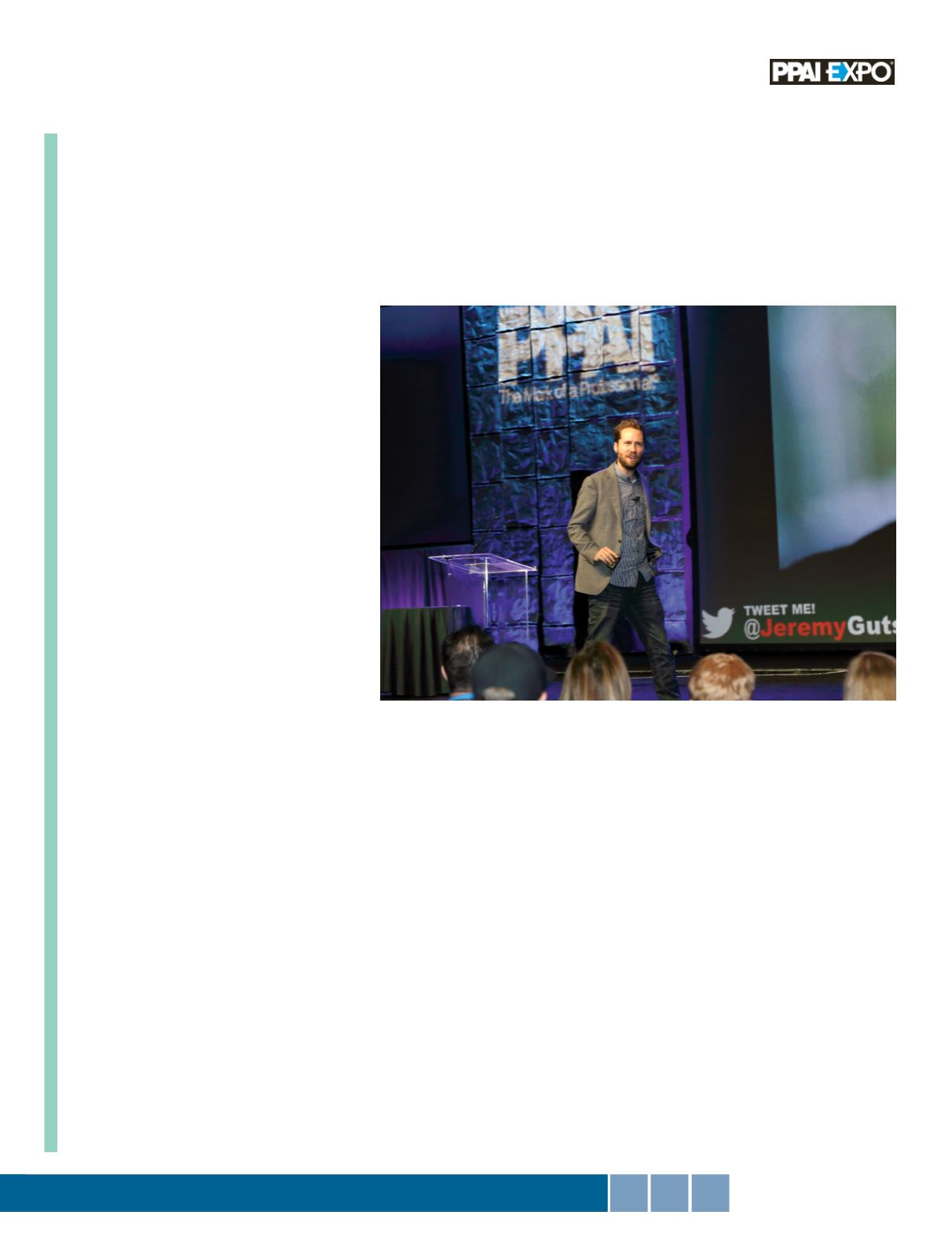
think,” says Jeremy Gutsche, founder of
Trendhunter.com and Monday afternoon’s
general session speaker. “Your break-
through is probably staring you in the face.
It’s about looking through all the chaos to
distill the patterns and make better deci-
sions.”
In a high energy, high speed presenta-
tion, “Better & Faster – The Proven Path To
Unstoppable Ideas,” Gutsche led his audi-
ence toward blockbuster innovations. But he
began his session with an admission. He was
an inveterate promotional products buyer.
Key chains. Bottle openers. Key chains that
were bottle openers. He’d used them all and
admitted that he would likely be in touch
with some of the companies at The PPAI
Expo about buying more.
For many, the challenge can be that their
success can get in their way and they
become complacent. Gutsche listed a few
high profile examples—Blockbuster, Blackberry, Smith
Corona, Encyclopedia Britannica—of companies, blinded by
their success, that missed opportunities. In each of these
cases, he said, they were run by smart people who found
something they were good at when new opportunities came
along, they retreated back.
Roy Raymond wanted to make it easier for men to buy
lingerie for their wives and significant others. He opened a
store, found some success, and opened a number of other
locations, repeating the model. When business started to
decline, he sold the company for $4 million. The new owners
refocused the chain, Victoria’s Secret, to cater to the women
who actually wore lingerie and today it’s worth north of $6
billion.
Gutsche used Raymond’s experience to illustrate the
three traps of the “farmer.” The farmer is complacent, as
once they’ve become successful they don’t push as hard.
The farmer is repetitive. And the farmer is protective of their
insight, which becomes a problem as the world changes
around them. He used the story of Amancio Ortega, founder
of Zara, to describe the three instincts of the “hunter.”
Zara’s ability to quickly bring products to the stores and
its responsiveness to customers’ wants has led to it being
lauded as “the most innovative and devastating retailer in
the world.” Ortega leads the company with the maxim, “The
daily task is marked by self improvement and the search for
new opportunity.”
Hunters like Ortega, Gutsche says, are insatiable. They
are never done finding new ideas. They are curious, expos-
ing themselves to different industries and new ideas. And
they are willing to destroy. Even products and processes
that worked in the past can be abandoned.
In looking at how businesses and individuals push them-
selves harder and where fresh ideas come from, Gutsche
says that he has identified six patterns of opportunity that
will lead to unstoppable ideas. The first is acceleration.
Supercharge one idea. The founders of the Tough Mudder
race noted that marathon runners valued completion as
much as actually winning the race. They created a competi-
tion that wasn’t about who came first but rather about the
experience. They took the idea from zero to $70 million in
two years.—JAMES KHATTAK
Jeremy Gutsche:
Identifying And
Following The Many Paths To Success